Japan is one of those destinations where a little knowledge changes the entire trip.
Tokyo alone can take days to understand. Kyoto’s best temples can be crowded by mid-morning. Some of the country’s finest hotels sit well outside the obvious tourist route. Restaurants may only accept reservations through a hotel concierge. Luggage can be sent ahead rather than dragged through railway stations. And trying to visit six cities in eight days is usually a good way to see a lot of train platforms.
At Clements Travel, we help clients slow the itinerary down, choose the right hotels, and make the routing work.
For a first visit, Tokyo and Kyoto remain essential. But Japan becomes far more interesting when you add a ryokan, the mountains, an island, Hokkaido, the Seto Inland Sea, or somewhere such as Kanazawa, Kyushu, or Miyajima.
Weather and the Best Time to Visit Japan
Japan can be visited year-round, but the experience changes considerably by season. For most first-time trips covering Tokyo, Kyoto, and Osaka, autumn is my personal favorite, and I would happily travel in winter too.
The reason is practical. Japan is a very active trip. It is quite normal to walk 15,000 to 20,000 steps a day, particularly in Tokyo and Kyoto. Doing that when it is 86°F (30°C) or more with high humidity is very different from doing it on a crisp autumn or winter day. Tokyo summer temperatures can reach around 95°F (35°C), while Kyoto regularly reaches the low to mid-90s°F (low to mid-30s°C) in July and August.
Autumn: Our Favorite Time
October and November are excellent months for most of central Japan:
- Humidity drops considerably from summer.
- Days are much more comfortable for walking and sightseeing.
- Autumn foliage starts farther north and works its way south, with Tokyo and Kyoto often at their best later in the season.
- October is generally milder, while November brings cooler evenings and stronger autumn color.
- Kyoto is particularly good at this time of year, although the most famous foliage sites can become busy.
If you are planning a trip around the autumn leaves, do not assume there is one fixed week that works for the whole country. Japan stretches a long way from north to south, so the foliage season moves through the country over several months.
Winter: Underrated
I also really like Japan in winter. Tokyo and Osaka tend to have plenty of clear days, while temperatures are much cooler and the air is generally dry. Tokyo's typical winter daytime temperatures are around 45°F to 55°F (7°C to 13°C).
If you are walking all day, you warm up quickly. Personally, I would rather put on a coat in the morning than spend a full day walking around Kyoto in August humidity.
Winter also works particularly well if you are adding:
- A ryokan and onsen stay
- Hokkaido or skiing in the Japanese Alps
- Snow country
- Winter illuminations and seasonal crab or hot pot dining
The main period to be careful with is New Year, particularly from late December into early January. Domestic travel becomes extremely busy and some businesses close or reduce their hours.
Spring: Excellent, but Busy
Spring is the season most people associate with Japan because of the cherry blossoms. The weather is generally mild, averaging 55°F to 70°F (13°C to 21°C), and very good for touring.
The downside is demand. Cherry blossom season brings large crowds, particularly to Tokyo and Kyoto, and the exact blooming dates vary each year. If seeing the blossoms is important to you, book early but accept that nature does not work to a hotel reservation calendar.
We are also cautious around Golden Week, which runs from late April into early May. This is one of Japan's busiest domestic travel periods, with packed trains and heavy demand for hotels.
Summer: We Would Think Carefully
Japan in summer is not impossible, and there are some excellent festivals, fireworks, and seasonal events. But for a classic city-based trip, it would not be my first choice.
June brings the rainy season across much of the country, followed by very hot and humid weather through July and August. August and September can also bring typhoons that affect travel plans.
The heat becomes particularly noticeable because Japan involves so much walking. A day that includes several temples, neighborhoods, train stations, and perhaps 20,000 steps can feel exhausting in high humidity.
If summer is your only option, we adjust the itinerary:
- Start touring earlier in the morning.
- Build in breaks during the hottest part of the day.
- Use private cars more frequently for local sightseeing.
- Avoid trying to cover too much in a single day.
- Consider Hokkaido or higher-altitude destinations where conditions are cooler.
We would also be cautious around Obon in mid-August, another major domestic holiday period when trains and hotels become very busy.
Seasonal Temperature Breakdown
- October to November (Autumn): 60°F to 75°F (16°C to 24°C). Our first choice for comfortable walking weather and autumn color.
- December to February (Winter): 45°F to 55°F (7°C to 13°C) in Tokyo and Kyoto. Cooler, dry, and often very comfortable once you are out walking. Bring a good coat.
- March to April (Spring): 55°F to 70°F (13°C to 21°C). Excellent sightseeing weather and cherry blossoms, but expect much higher demand during peak bloom.
- May to June (Late Spring / Early Summer): 70°F to 80°F (21°C to 27°C). Still a good time to travel, although humidity increases and the rainy season begins during June across central Japan.
- July to August (Summer): 85°F to 95°F+ (29°C to 35°C+), accompanied by high humidity. Our last choice for a sightseeing-heavy Tokyo, Kyoto, and Osaka itinerary.
Flying to Japan
Most of our clients start their trip in Tokyo, which has by far the best choice of international flights into Japan. Tokyo has two main airports, Haneda and Narita, and given a similar flight and fare we nearly always prefer Haneda. It is much closer to the city, and after a long flight that makes a real difference. From Haneda you can be at a central Tokyo hotel in around 25 to 35 minutes, while Narita is about 40 miles (60 km) out and can easily take an hour or more depending on traffic.
Narita is still a perfectly good airport, and we would not tell you to avoid it if the flight is better. Sometimes the aircraft, schedule, or fare makes Narita the better option, so we look at the whole journey rather than just the airport code.
Most first trips then move through Japan by train, often Tokyo to Kyoto and then on to Osaka or another regional stop. In some cases it is possible to fly home from Osaka, which can work very well because it avoids returning to Tokyo at the end of the trip. The issue is that Osaka does not have the same range of nonstop long-haul flights, so quite often the best flight home is still from Tokyo.
When that happens, we usually recommend returning to Tokyo for one final night rather than trying to connect straight through to an international flight. Our favorite option for this is Four Seasons Hotel Tokyo at Marunouchi. It is right by Tokyo Station, so when you arrive back on the Shinkansen you are not dragging luggage across the city just to spend one night in another hotel. You get off the train, head to the hotel, stay the night, and transfer to the airport the next day. It keeps the end of the trip easy.
Flying from the United States and Europe
- From the United States: Nonstop connections depart from major gateways including Los Angeles, San Francisco, Seattle, New York, Chicago, Dallas, Houston, and Washington. Flights from the West Coast take 10 to 12 hours; from the East Coast, allow 13 to 15 hours. We generally prefer one clean connection onto a nonstop transpacific flight rather than adding several domestic sectors.
- From Europe: Nonstop links operate from London, Paris, Frankfurt, Munich, Helsinki, Rome, and Milan. Typical flight times are around 12 to 15 hours.
Flagship First and Business Class Cabins
For a flight of 10 to 15 hours, we pay close attention to the exact aircraft and seat rather than just the airline name:
- Japan Airlines A350-1000 First Class: Just six private suites in a 1-1-1 layout. Each suite has a 43-inch 4K screen, personal wardrobe, minibar, and a large amount of private space. The seat converts into a bed up to 80 inches (203 cm) long. The A350-1000 operates selected services between Haneda and New York JFK, Dallas/Fort Worth, Los Angeles, London Heathrow, and Paris.
- ANA "The Suite" First Class: ANA's flagship First Class on selected Boeing 777-300ER aircraft. Only eight suites, each with its own closing door, fully flat bed, personal wardrobe, and a 43-inch 4K screen.
- ANA "The Room" Business Class: One of the Business Class products we particularly like for Japan. Exceptionally wide seats with closing privacy doors, direct aisle access, and lie-flat comfort on selected Boeing 777-300ERs.
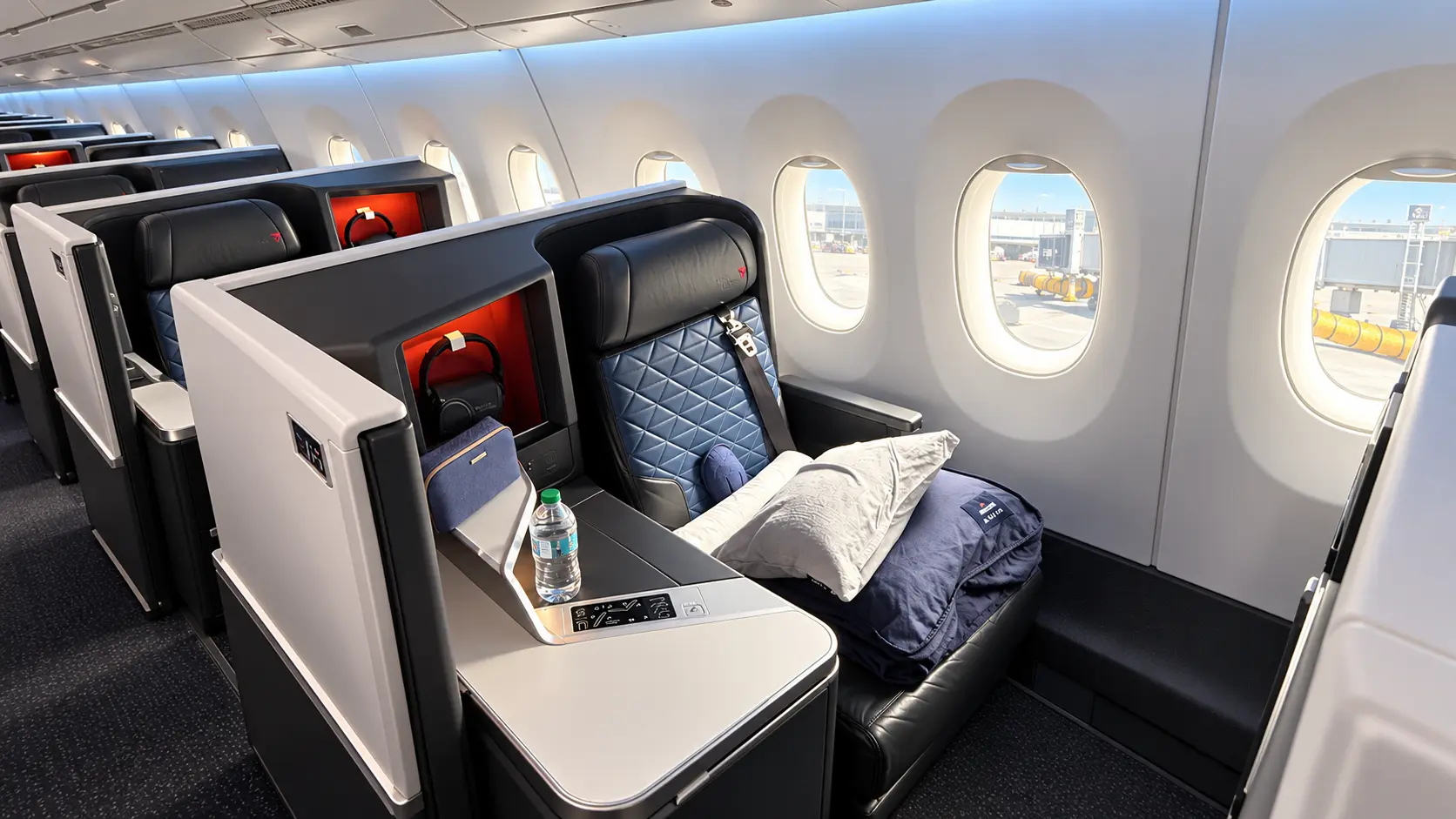
- Delta One Suites: Business Class featuring a closing privacy door and fully flat bed on Airbus A350 and A330-900 aircraft. Particularly useful for clients starting in Delta hubs such as Atlanta, Detroit, Minneapolis, or Seattle, where a nonstop flight into Haneda beats an extra connection purely to fly an Asian carrier.
.webp)
A Word on Jet Lag
Jet lag can hit quite hard when arriving from the United States. It is not unusual to wake up at 2:00 or 3:00 in the morning feeling wide awake.
Spend enough time in Tokyo hotels and you will see the same scene fairly often: American guests wandering around the lobby in the middle of the night, or heading down to the nearest 7-Eleven looking for coffee and snacks because their body thinks it is lunchtime. Some hotels have adapted to this. Four Seasons Hotel Tokyo at Otemachi, for example, provides hot drinks and light snacks overnight for guests awake at unusual hours.
For most people, the worst of it passes after two or three days. Keep your first day or two fairly light: do not land in Tokyo and immediately schedule a full day of private touring, an important dinner, and a 7:00 am start the following morning.
Transport in Japan
For most Clements Travel itineraries, we rarely recommend flying within Japan unless the journey is continuing to Hokkaido, Okinawa, or one of the more remote islands.
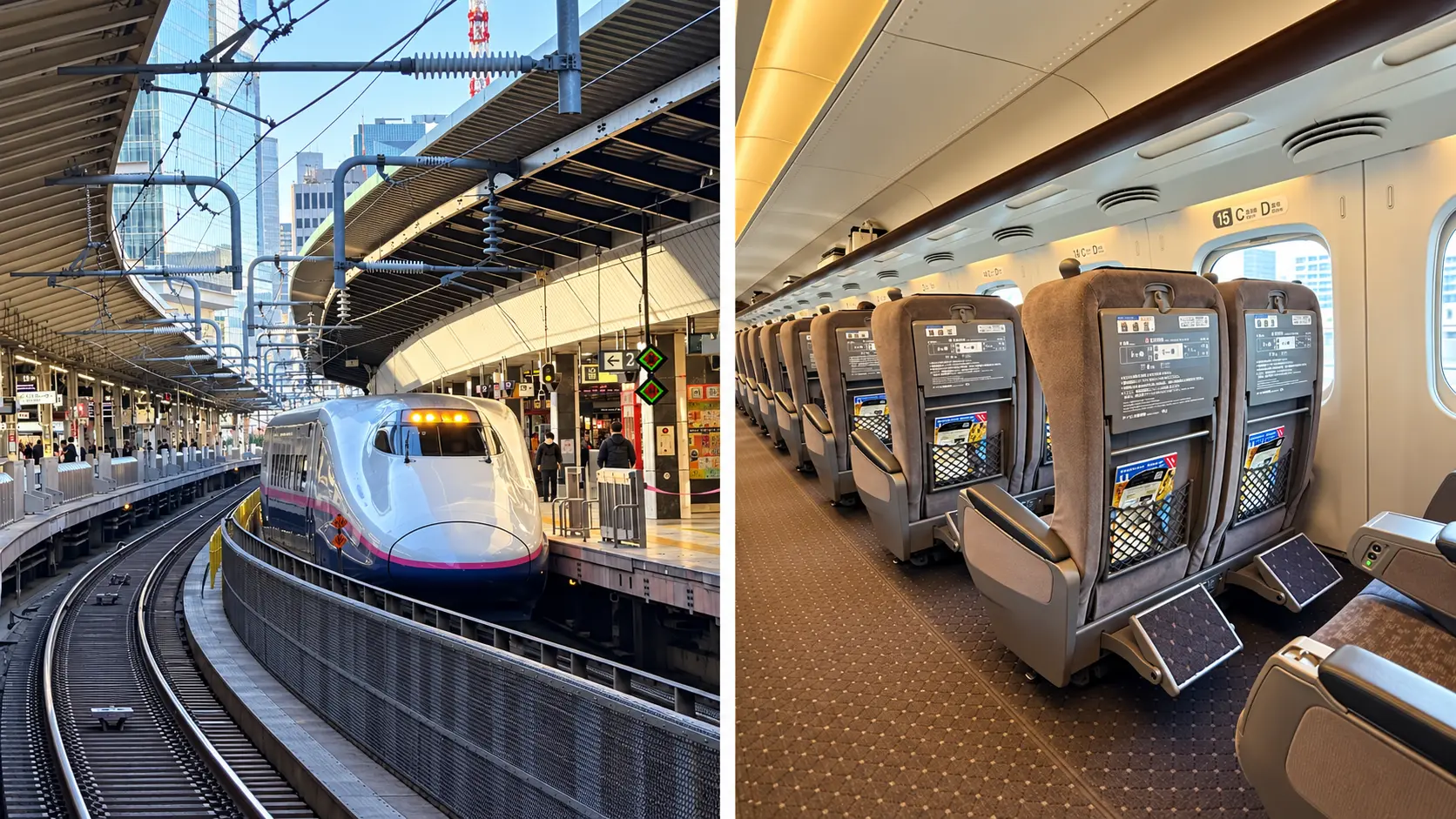
For the main tourist routes, rail is usually the better experience. Japan's trains are fast, clean, punctual, and generally very comfortable. The Shinkansen also takes you from city center to city center, avoiding airport transfers, security lines, and the extra time involved with domestic flights.
The main exception is some of the more regional journeys. Trains heading into areas such as Ise-Shima, for example, when traveling to Amanemu, can feel noticeably older depending on the service selected. They are still clean and reliable, but there can be less legroom, less luggage space, and more limited English spoken at smaller stations. If that part of the journey does not appeal, we can replace the regional train with a private ground transfer.
Common Train Journey Times
- Tokyo to Kyoto: Approximately 2 hours 15 minutes on the fastest Nozomi Shinkansen services.
- Kyoto to Osaka: Approximately 28 minutes between Kyoto Station and central Osaka Station on the JR Special Rapid Service. (The Shinkansen takes only around 14 minutes from Kyoto to Shin-Osaka, but Shin-Osaka is not central Osaka, so the regular JR service is often more convenient overall).
- Tokyo to Kanazawa: Approximately 2 hours 30 minutes via the Hokuriku Shinkansen.
- Tokyo to Nara: Allow around 3 hours 15 minutes. There is no direct Shinkansen to Nara, so you travel from Tokyo to Kyoto and change there for a train or private transfer to Nara.
Ordinary Class or Green Car?
- Ordinary Car: The standard class and already very good. Seats are comfortable, the cars are quiet, and there is plenty of space compared with standard economy on an aircraft (arranged in a 3x2 layout).
- Green Car: The premium cabin, effectively Japan's first-class rail product. Arranged in a 2x2 layout, seats are wider, there is more personal legroom, footrests are provided, and the car generally feels calmer. We recommend Green Car for clients who value extra personal space, quieter surroundings, or are taking several longer rail journeys.
- Gran Class: Available only on select northern and western routes (such as the Hokuriku line to Kanazawa). Configured with just 18 leather reclining pods per car and dedicated attendant service, it operates like a boutique luxury cabin. Note: Gran Class is not offered on the Tokaido line between Tokyo, Kyoto, and Osaka.
Food and Drinks on the Train
Regular trolley cart service has been phased out on standard Tokaido Shinkansen cars. While Green Car passengers can access a mobile ordering system via QR code for light refreshments, the selection remains minimal.
We recommend buying what you want before boarding. Large railway stations have convenience stores, bakeries, and shops selling ekiben, Japanese boxed meals designed specifically for train travel. Buying an ekiben and chilled local tea or sake before boarding the Shinkansen is an integral part of the experience.
Luggage on Japanese Trains
Finding somewhere to store large suitcases can be a real pain on busy trains. Overhead racks are not suitable for every bag, designated luggage areas fill quickly, and luggage with total dimensions above 63 inches (160 cm) requires an advance seat reservation on the Tokaido, Sanyo, and Kyushu lines.
For that reason, we often recommend Japan's luggage-forwarding services (takuhaibin) rather than taking every suitcase onto every train. Your larger bags can be sent directly from one hotel to the next while you travel with a smaller overnight bag. This works particularly well if you are stopping at a ryokan, Amanemu, or another regional property between the major cities.
When Do We Book Your Train Tickets?
Most reserved JR train tickets are formally released around one month before travel. If you book your Japan trip with us six or nine months ahead, do not worry if your train tickets are not confirmed immediately. We secure the hotels and overall itinerary first, then book the appropriate trains as the booking window opens.
Single Tickets or a Japan Rail Pass?
Following substantial price increases, individual train tickets are almost always better value for the itineraries we arrange. For a client traveling from Tokyo to Kyoto, then Kyoto to Osaka, buying individual tickets is more sensible and allows us to book the fastest Nozomi and Mizuho trains without restriction.
Why We Don't Drive Between Major Cities
Private cars have an important place in an itinerary, but Tokyo to Kyoto is not where we use them. The Shinkansen takes a little over two hours; driving between the cities takes many hours before you even account for expressway congestion leaving Tokyo or arriving into Kyoto.
We would rather put you on a reserved Shinkansen and use private drivers where they add far more value: airport transfers, private touring, countryside journeys, and reaching ryokans that are less convenient by rail.
The Japanese Luxury Car Is Not Always a Mercedes
Clients sometimes ask specifically for a Mercedes-Benz S-Class or E-Class. In Japan, we often recommend something different: the Toyota Alphard Executive Lounge or the Lexus LM.
These are not conventional passenger vans. Rear passengers have large individual captain's chairs, powered ottomans, extensive legroom, privacy glass, individual climate controls, and exceptionally quiet cabins. On longer journeys, the rear seats can recline deeply enough to lie virtually flat, making resting considerably easier than in a conventional sedan. On my last trip to Japan, my airport transfer to Narita had seats that reclined all the way flat. It was an outstanding way to travel after a long flight.
Timing Private Transfers
With road transfers, departure time is just as important as the vehicle. Leaving central Tokyo for Hakone or Mount Fuji on a Friday afternoon, for example, is a recipe for disaster as weekend outbound traffic clogs the Tomei Expressway. A journey that should take 90 minutes can easily turn into three hours. We plan departure times carefully around local traffic patterns or use express rail for part of the route.
Where to Stay in Japan
Japan has an exceptional luxury hotel scene and almost every major hotel group is represented. Four Seasons alone has two hotels in Tokyo plus properties in Kyoto and Osaka. You also have Ritz-Carlton, Aman, The Peninsula, Mandarin Oriental, Park Hyatt, Rosewood, Bulgari, and many of Marriott's luxury brands.
One thing that surprises people is how new many of the best hotels are. Japan's luxury market has expanded very quickly, so you can choose between classic Japanese hotels that have been around for years and a new generation of properties with huge rooms, pools, spas, and extensive facilities.
The Newer Generation
Four Seasons Hotel Tokyo at Otemachi is a great example. The rooms are large by Tokyo standards, starting at around 527 sq ft (49 sq m), and the hotel has a 65-foot (20-meter) indoor pool, spa, Japanese baths, and several restaurants and bars. It is one of those newer Tokyo hotels where you could happily spend half the day in the hotel without feeling you should be somewhere else.
Then there are newer arrivals such as Bulgari Hotel Tokyo, Janu Tokyo, and Four Seasons Hotel Osaka. More continue to open across the country, so the hotel landscape in Japan changes quite quickly.
Bulgari deserves one small warning for points-focused travelers: although Bulgari Hotels & Resorts sits within Marriott International's broader portfolio, Bulgari properties do not participate in Marriott Bonvoy. That means no Bonvoy points earning or redemption and no standard Bonvoy elite benefits.
The Classics
New does not automatically mean better.
The Peninsula Tokyo is still one of our favorite hotels in Japan. It feels polished, very Japanese, and has a sense of place that some of the newer international hotels do not quite have. Depending on the client, I would still choose it over plenty of hotels that opened much more recently.
This is why we do not start with "what is the newest hotel?" We start with what sort of hotel you like.
The Destination Hotels
Some Japanese hotels are worth building the itinerary around.
The Aman properties fall into this category. Aman Tokyo, Aman Kyoto, and Amanemu are expensive even by Japanese luxury hotel standards, but these are signature properties and the quality is exceptional. Amanemu is particularly interesting because it takes you into the Ise-Shima National Park area rather than another major city. Aman is also expanding with Aman Niseko planned for Hokkaido.
Rosewood Miyakojima is another example. It gives you a very different side of Japan, with beaches and island life rather than temples and city sightseeing.
Choosing the Right Hotel
In Japan, location is just as important as the brand. Tokyo is the best example: staying in Otemachi or Marunouchi gives you a very different trip from staying in Shinjuku, Ginza, or Toranomon.
We normally look at:
- Room size and layout
- Exact location
- Connecting room availability
- Maximum occupancy rules
- Pool and spa facilities
- Restaurant and concierge strength
- Access to rail stations and ease of airport transfers
Room size becomes particularly important for families. Connecting rooms are not as common as some clients expect, and Japanese hotels can be strict about maximum occupancy.
A very good concierge is also worth more in Japan than in many destinations. Restaurant bookings, luggage forwarding, train arrangements, and local logistics are all much easier when you have a good hotel team behind you.
Preferred Partner Benefits
Many of Japan's best luxury hotels are part of preferred partner programs that give our clients extra benefits for the same hotel rate, or sometimes less when a preferred offer is available.
Clements Travel has access to programs including Four Seasons Preferred Partner, Peninsula PenClub, Mandarin Oriental Fan Club, Marriott STARS & Luminous, Hyatt Privé, Rosewood Elite, Hilton Impresario, IHG Destined, Virtuoso, and others.
Depending on the hotel and program, benefits can include:
- Daily breakfast for two
- Hotel or resort credit (typically $100 equivalent)
- Priority for room upgrades
- Early check-in and late checkout, subject to availability
- Welcome amenities
- Additional recognition from the hotel before arrival
Our Guest Experience team works directly with the hotel before arrival to reconfirm preferences and celebrations, and push for the best available upgrade where the program allows it. You still pay the hotel directly; our rates are the same as booking with the hotel, or occasionally better when a preferred offer is available.
What About Staying in a Ryokan?
We get asked about ryokans all the time.
A ryokan is a traditional Japanese inn, usually with tatami rooms, Japanese-style bathing, futon bedding, and often a multi-course kaiseki dinner and Japanese breakfast. It sounds like something everyone should do once. I would just be careful about which one you choose.
Some of the older ryokans can be poorly insulated and cold in winter. Sleeping on a futon close to the floor can also be uncomfortable if you are tall, older, or have knee, hip, or back problems. Sitting close to floor level for meals and repeatedly getting up and down sounds minor until you are living it.
Then there is the cultural side. A very traditional ryokan can mean fixed meal times, elaborate Japanese food morning and night, shoes off, floor seating, and a fairly structured stay. Some people absolutely love it. Others love the idea of it and, after about six hours, would quite like a normal bed, a chair with a back, and something familiar to eat.
If you want the full experience, there are exceptional ryokans. Gora Kadan in Hakone is one of the benchmarks, set on the former grounds of an Imperial Family summer villa, with hot springs and traditional kaiseki dining. Asaba on the Izu Peninsula is another, with traditional rooms but also some newer suites that offer standard beds and considerably more space.
For many of our clients, though, there is a middle ground. Four Seasons Hotel Osaka's GENSUI floor gives you tatami rooms, Japanese design, and a modern ryokan-style experience, but you still have the heating, plumbing, restaurants, spa, and service of a new luxury hotel. You get a taste of the tradition without feeling that you have sacrificed comfort.
For clients who really want the full ryokan experience, we will recommend one. For clients who like the idea of it more than the reality, we will say that too.
Dining in Japan
Food is one of the biggest reasons to go to Japan, and for some of our clients it becomes the main focus of the trip. The top end of Japanese dining works very differently from New York, London, or Paris, so it helps to understand the basics before you start booking.
Michelin Is Not the Whole Story
In Japan, Tabelog is often just as useful as Michelin, and sometimes more useful. The ratings are harsh, so do not judge them like standard online reviews:
- 3.50 to 3.74: Usually very good and often worth going out of your way for.
- 3.75 to 3.99: Some of the best restaurants in Japan.
- 4.00+ (Tabelog Silver & Gold): Extremely sought-after and often very hard to book.
Some Restaurants Are Effectively Closed to First-Time Guests
A number of Japan's best sushi, tempura, and kaiseki restaurants do not accept public reservations at all. Some only accept regular guests or personal introductions (ichigensan okotowari). Others release seats on one specific day each month, open 60 to 90 days ahead, or use reservation services such as Omakase or Tableall. Tiny counters may have only six to eight seats.
This is why your hotel concierge can be important. Concierge teams at hotels such as The Peninsula Tokyo, Palace Hotel Tokyo, Aman Tokyo, and Four Seasons have long-standing relationships with restaurants around the city. A restaurant may be much more comfortable accepting a booking from a concierge it already knows than from an overseas guest it has never dealt with before.
That still does not mean every table is possible. We usually get better results if you tell us what style of dining you want rather than insisting on one exact restaurant (for example: Edomae sushi in Ginza, high-end tempura, traditional kaiseki in Kyoto, or wagyu and sukiyaki).
Omakase Etiquette
You do not need to memorize dozens of rules. A few basics are enough:
- Avoid perfume or cologne: High-end sushi and kaiseki rely on delicate aromas. Heavy fragrance can spoil the experience for other diners, and chefs have been known to refuse entry.
- Arrive on time: Counters often start serving all guests simultaneously.
- Eat the sushi when it is served: Nigiri is served at the ideal temperature and should be eaten within seconds, not left on the plate while you take photos.
- Ask before taking photos, and never use flash.
- Trust the chef with seasoning: High-end sushi is already brushed with seasoned soy (nikiri); avoid drowning your food in extra sauce.
Dietary Restrictions Need Planning
Japan can be difficult for complicated dietary requirements. The biggest issue is dashi, the stock used throughout Japanese cooking. It almost always contains bonito (fish flakes) and appears in soups, sauces, and even vegetable dishes.
At high-end sushi, tempura, and kaiseki restaurants, menus are fixed and some chefs will not make major changes. Tell us early if you have severe seafood allergies, soy allergies, or strict gluten-free, vegan, or kosher requirements. In some cases, high-end teppanyaki, contemporary Japanese dining, or Buddhist vegetarian cuisine (shojin ryori) work much better than an omakase counter.
Do Not Book Omakase Every Night
This is a common mistake. People go to Japan and decide every dinner needs to be a major culinary event. By night four they are tired of sitting through another three-hour tasting menu.
Mix it up:
- One serious sushi or omakase dinner
- One kaiseki meal in Kyoto
- A dedicated tempura counter
- Skewered yakitori grilled over binchotan charcoal
- High-grade wagyu or sukiyaki
- A lively neighborhood izakaya
- A casual bowl of ramen
- One or two unplanned evenings
Do Not Ignore the Food Halls
Japan's department store food halls, known as depachika, are exceptional. Look at places such as Isetan Shinjuku, Ginza Mitsukoshi, or Nihombashi Takashimaya. You will find pristine sushi, bento, pastries, seasonal fruit, and prepared dishes. They are ideal for a casual lunch or picking up an ekiben before boarding the Shinkansen.
Our approach is to book the restaurants that really need booking and leave some evenings open. After walking 20,000 steps around Tokyo, a bowl of ramen and a cold beer often sounds much better than another formal multi-course menu.
Top 10 Places to Visit in Japan
- Tokyo (4 to 5 nights): Huge, energetic, and like nowhere else. Treat your first day as a jet lag day: check in, go for a walk, and avoid booking anything demanding. Group your touring geographically to avoid crossing the city repeatedly.
- Kyoto (3 to 4 nights): Preserved streets, gardens, temples, and Gion. Avoid trying to see every temple, and walk through Higashiyama early in the morning before daytime crowds arrive.
- Osaka (2 to 4 nights, or longer as a base): Known as Japan's Kitchen. Lively, less formal than Tokyo, and outstanding at night. Also serves as an excellent rail base for exploring Kyoto, Kobe, Nara, and Hiroshima.
- Hakone & Mount Fuji (1 to 2 nights): An easy addition between Tokyo and Kyoto. Slow down, stay in a ryokan, enjoy an onsen, and send your main luggage directly ahead to Kyoto.
- Hiroshima & Miyajima (1 to 2 nights): The Peace Memorial Museum paired with the coastal tranquility and famous floating torii gate of Miyajima. Staying overnight lets you experience the island after daytime visitors leave.
- Amanemu & Ise-Shima National Park (2 to 3 nights): Coastal landscape overlooking Ago Bay, thermal mineral baths, and the sacred Ise Jingu shrine complex. Outstanding for slowing the pace down.
- Kanazawa (2 nights): Preserved samurai districts, geisha teahouses, Kenroku-en garden, and exceptional seafood. (Note: the train between Kanazawa and Kyoto now involves a quick platform change at Tsuruga).
- Hokkaido (4+ nights): World-class powder snow and skiing in winter; cooler weather, national parks, and superb seafood in summer.
- Naoshima & the Seto Inland Sea (2 nights): Contemporary art museums, outdoor sculpture, and Tadao Ando architecture set across quiet coastal islands.
- Okinawa & the Southern Islands (3 to 5 nights): Subtropical beaches, coral reefs, and distinct Ryukyu culture. An ideal, restful finish after two weeks of active sightseeing on the mainland.
If this is your first trip, do not try to see all ten. For around 10 days, start with Tokyo → Kyoto → Osaka (adding Hakone for a ryokan). Trying to cram in too many regions turns a vacation into a transit schedule.
Recommended 10-Day Japan Routes
Route 1: The Classic First Trip
- Tokyo (4 nights) → Kyoto (3 nights) → Osaka (2 nights)
- Best for: First-time visitors who want the definitive highlights without overcomplicating transit.
- Start with four nights in Tokyo to settle in. Take the Shinkansen west to Kyoto for three nights of temples, gardens, and historic neighborhoods. Finish with two nights in Osaka for food and nightlife before departing from Kansai International Airport (or returning to Tokyo for your flight home).
Route 2: Add a Ryokan
- Tokyo (3 nights) → Hakone (1 night) → Kyoto (3 nights) → Osaka (2 nights)
- Best for: First-time visitors who want a traditional ryokan and onsen experience.
- Spend three nights in Tokyo, then travel to Hakone for one night in a ryokan to enjoy hot springs and kaiseki dining. Send your larger luggage straight from Tokyo to Kyoto, traveling to Hakone with an overnight bag. Continue to Kyoto and finish in Osaka.
Route 3: Stay Put in Osaka
- Tokyo (3 nights) → Osaka (6 nights)
- Best for: Food lovers and anyone who prefers unpacking only twice.
- Spend three nights in Tokyo, then base yourself in Osaka for the rest of the trip. From Osaka you can easily take day trips to Kyoto (28 minutes by train), Kobe (25 minutes), Nara, and Hiroshima. You trade quiet early mornings in Kyoto for the convenience of staying in a vibrant culinary city without constantly repacking.
Route 4: Add Kanazawa
- Tokyo (2 nights) → Kanazawa (2 nights) → Kyoto (3 nights) → Osaka (2 nights)
- Best for: Repeat visitors or travelers who want something beyond the standard route.
- Head northwest by Shinkansen from Tokyo to Kanazawa for gardens, crafts, and samurai history. Continue to Kyoto (taking the Shinkansen to Tsuruga and changing to the Thunderbird express) for three nights, finishing with two nights in Osaka.
Which Route Would We Choose?
- First trip: Route 1
- First trip with a ryokan: Route 2
- Fewer hotel changes and lots of food: Route 3
- Something slightly different: Route 4
10 Things in Japan That Can Catch You Out
- The hotel concierge cannot perform miracles: Hospitality staffing is tight, and concierge desks at top hotels handle hundreds of requests during peak seasons. Send important dining requests well ahead rather than asking three days before arrival.
- You cannot book the whole trip at once: You may confirm your hotel nine months ahead, but JR bullet train seats open 30 days prior, and elite dining counters release seats on monthly cycles. We secure the hotels first and build the rest as windows open.
- Luggage needs its own plan: Luggage forwarding via Yamato (takuhaibin) is excellent, but it is typically next-day delivery (or 48 hours for remote areas). Always keep an overnight bag with you for intermediate stops.
- Give yourself more time at railway stations: Tokyo Station is an underground city, and Shinjuku is the busiest station in the world. Arrive with plenty of time to find your correct platform and car before departure.
- Regional trains are a different experience: While the Shinkansen is modern and spacious, rural trains (such as those into Ise-Shima) can be older with limited luggage space and minimal English signage. Private transfers are often well worth considering for rural legs.
- The most traditional ryokan is not always the best one for you: Sleeping on low futons, sitting on tatami floors, and adhering to strict meal times can be hard work for some guests. Match the property to your comfort level, or consider modern alternatives like the GENSUI floor at Four Seasons Osaka.
- Kyoto needs to be planned around the crowds: Sights like Kiyomizu-dera and Arashiyama become heavily congested by midday. Plan your key sightseeing early in the morning or late in the afternoon.
- Restaurant reservations are much less flexible: Small counters seat all guests simultaneously. Arriving late can ruin the meal's pacing, and last-minute cancellations incur 100% penalties. Also, remember to leave perfume and cologne in your room.
- Japanese holidays can change the trip: Golden Week, Obon, and New Year bring intense domestic travel. Trains become fully booked, JR operates bullet trains as all-reserved seating, and hotel availability disappears.
- Families need room configurations checked carefully: Japanese hotels enforce strict headcount limits per room based on municipal licensing. Large suites may legally permit only two or three guests. Connecting rooms must be confirmed directly with hotel management rather than assumed.
Planning a Trip to Japan?
None of this should put you off. Japan is one of the easiest, safest, and most rewarding countries in the world to explore.
The difference is that luxury travel in Japan does not mean stripping away every train journey, local tradition, or bit of cultural nuance. It means knowing which parts work brilliantly on their own, and which parts need thoughtful planning to keep the journey calm, easy, and unhurried.
Tell us your dates, how long you have, and whether this is your first visit. We can help with the route, hotels, preferred partner benefits, trains, private transfers, and the parts of the trip that are worth booking early.
Start planning your Japan journey with Clements Travel.